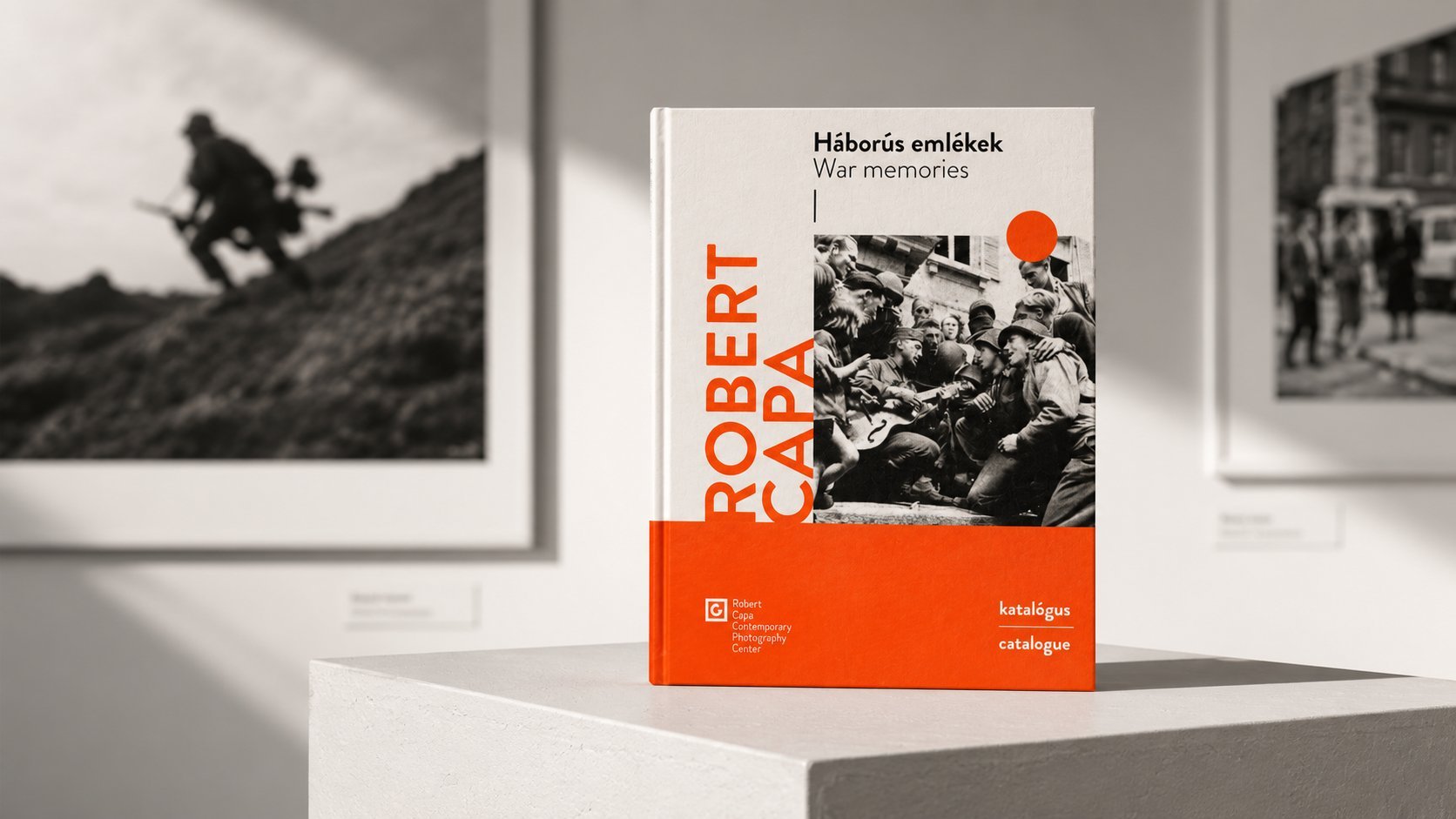
Robert Capa: War Memories
The bilingual exhibition catalog for the Robert Capa Contemporary Photography Center in Budapest — "Háborús emlékek / War Memories," drawn from a collection of more than 2,000 prints, negatives, and documents.
Robert Capa: War Memories is the catalog designed for the Robert Capa Contemporary Photography Center in Budapest, drawn from a collection of more than 2,000 vintage and modern prints, contact sheets, negatives, and documents from Capa's archive. The selection focuses on his war reportage — among the most defining photojournalistic work of the 20th century — presented as a bilingual Hungarian/English publication, "Háborús emlékek / War Memories," built to read equally as an exhibition companion and a standalone reference object.
The Brief
The Robert Capa Contemporary Photography Center — whose collection holds more than 2,000 vintage and modern prints, contact sheets, negatives, and documents from Capa's archive — commissioned the catalog for its war-reportage exhibition. The brief called for a bilingual Hungarian/English publication that could serve both roles a museum shop object needs to play: substantial enough for a scholar, direct enough for a first-time visitor.
War, and What Comes After
The concept follows the museum's own framing of the collection: these photographs are not only historical documents, but universal moments of human experience. The cover carries that idea before the reader opens the book — not a battlefield image, but a photograph of soldiers celebrating, an accordion and a crowd of tired, smiling faces. War Memories, the title insists, is not only combat; it is everything a camera keeps around it.
Cream, Cloth & Capa Orange
The cover is bound in cream cloth, with ROBERT CAPA set in the museum's signature orange and rotated to run the full height of the spine — legible on the shelf as much as on the table. A single black-and-white photograph sits inset on the upper cover, marked by one orange circle, a quiet graphic device that recurs through the identity as a full stop, a wound, a sun. A solid orange base band carries the Robert Capa Contemporary Photography Center mark alongside the bilingual "katalógus / catalogue" label.
A Bilingual Grid
Every spread runs Hungarian and English in parallel — introductory texts set as twin columns, photograph captions paired underneath each full-bleed plate with location, date, and credit in both languages. The photographs are left to run to the trim with almost no interruption: Capa's Allied landing at Omaha Beach, Normandy, June 6, 1944, and a soldier caught mid-stride in Tunis, 1943, each given a full spread with nothing competing for the reader's attention.
Outcome
The result is the exhibition's companion publication and one of the most significant pieces in this editorial practice — a catalog built on the same conviction as the collection it represents: that Capa's war photographs are historical record and human memory at once.