La Casa de Bernarda Alba
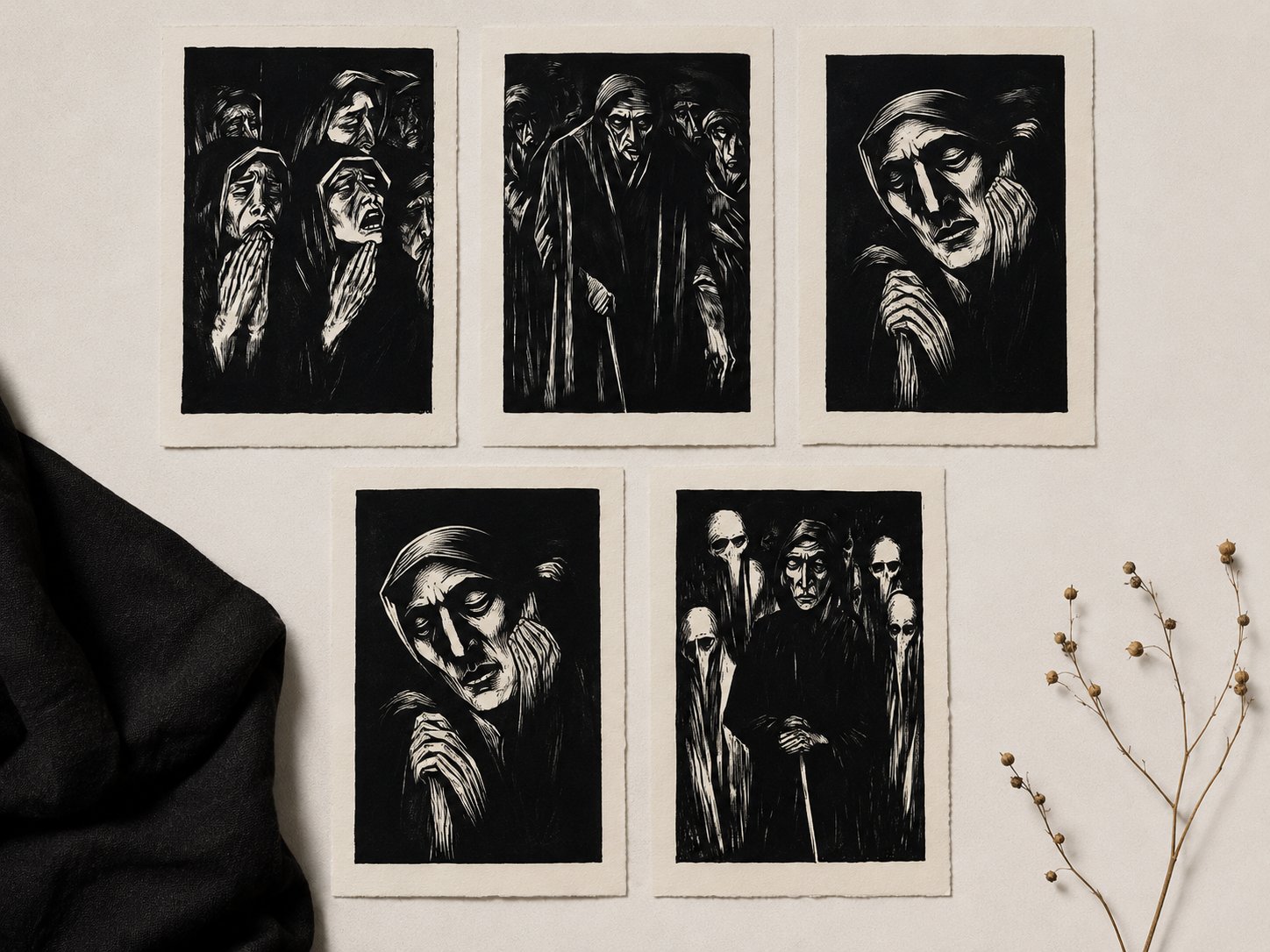
A series of editorial illustrations inspired by Federico García Lorca's tragedy — rendered in digital engraving to capture the repression, darkness, and dramatic tension of the play.
A personal editorial illustration series interpreting Federico García Lorca's 1936 tragedy through digital engraving. Dense cross-hatching, stark contrasts, and a restricted black-and-ochre palette evoke the play's claustrophobic repression rather than illustrating its text literally. The series portrays Bernarda, Adela, the daughters, Poncia, and the absent Pepe el Romano as a unified visual narrative, drawing from the tradition of Goya's prints and early-20th-century expressionist illustration.
The Project
A personal editorial illustration project: a visual interpretation of Federico García Lorca's La Casa de Bernarda Alba (1936), one of the defining works of 20th-century Spanish theatre. The challenge was to translate the claustrophobic atmosphere, the charged silences, and the conflict between repression and desire into a unified series of images — without illustrating the text literally, but rather its emotional and symbolic core.
Visual Research
The engraving aesthetic was chosen deliberately: it evokes the historical period of the play (rural Andalusia, 1930s), the weight of tradition, and the physicality of marks cut into a surface — a formal analogy for repression itself. Research drew from the tradition of Spanish and European woodcut printing, from Goya's Los Caprichos and Los Desastres de la Guerra, and from expressionist theatrical illustration of the early 20th century.
Digital Engraving
Each illustration was developed digitally, simulating the visual vocabulary of relief printing: dense cross-hatching, strong directional lines, stark value contrasts, and deliberate absence of continuous tone. The palette is deliberately restricted — black, deep ochre, and selective use of white — to reinforce the austerity and moral rigidity that governs Bernarda's house.
Illustrations
The series depicts key figures and moments from the play: Bernarda as an architectural presence, rigid and immovable; Adela as the single point of rupture in the visual field; the daughters as a chorus of contained figures; Poncia as witness; and the absent Pepe el Romano — felt but never seen. Each piece functions independently and as part of a unified visual narrative.
Outcome
The series constitutes a complete visual interpretation of the play, functioning as an independent editorial project and as a demonstration of the engraving illustration discipline within the portfolio. It establishes a distinctive visual language for literary and theatrical illustration that draws from historical printmaking tradition while operating entirely within a digital workflow.